
As the world gathers in the collective effort towards a net-zero future, sustainable mobility undoubtedly becomes a key driving force for this goal. The mainstream adoption of battery electric vehicles (“BEVs”) in recent years have only accelerated this shift towards the future with BEV manufacturers boasting of reduced emissions, quieter and smoother operations amongst many other benefits over the traditional internal combustion engine (“ICE”) vehicles. However, are BEVs truly ‘cleaner’ in reality?
To explore this problem, one must first understand the differences in energy sources that ICE vehicles and BEVs run on. BEVs run fully on electricity and do not possess a tailpipe while ICE vehicles run typically on petrol or diesel which results in the emission of greenhouse gases from the tailpipe.
At first glance, one might quickly conclude that BEVs have no emissions and are thus cleaner than ICE vehicles, but that may not necessarily be the case. The emissions from BEVs are produced during the generation of electricity they run on. If the primary source of energy to power these BEVs is not carbon-free, then BEVs do indeed “emit” greenhouse gases. For instance, if the BEVs run on electricity generated from the burning of fossil fuels, it doesn’t matter if the BEVs are not polluting while being driven – the greenhouse gases are already released in the power plant that produced the electricity.
This means that if you’re driving a BEV in the US, where fossil fuels accounted for 60.8% of the country’s energy production in 2021 for example, you will probably release more greenhouse gases into the atmosphere than if you’re driving a BEV in Iceland, that runs almost entirely on hydro, geothermal and solar energy.
Fortunately, in Singapore, 95% of our electricity is generated from natural gas, one of the cleanest forms of fossil fuels that produces the least amount of carbon emissions per unit of electricity. This supports the claim that EVs can indeed be ‘cleaner’ in Singapore, but the same claim may be less valid in the context of other countries.
Also, it is worthy to note that the entire emission spectrum for vehicles (whether BEVs or ICE vehicles) has to consider not just its primary fuel sources but also the manufacturing and end-of-life process, which would also result in greenhouse gas emissions. For example, the production of the battery for BEVs is a major source of emissions due to the need for new materials. Studies conducted by the US Environmental Protection Agency (“EPA”) have shown that lifecycle greenhouse gas (GHG) emissions for EVs are nonetheless generally lower than that of gasoline vehicles.
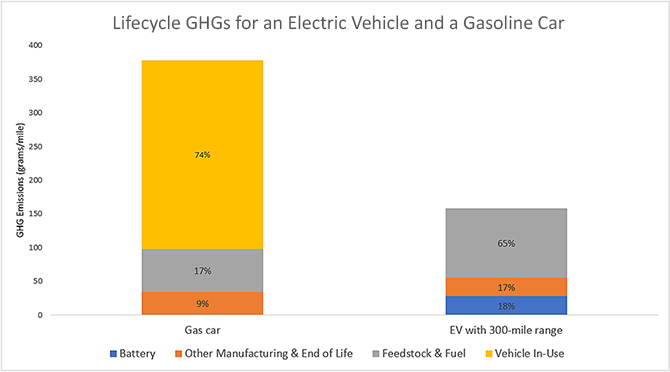
Lifecycle GHG emissions for EV vs Gasoline Car (Photo: US EPA)
While the study by EPA concluded that BEVs are indeed less pollutive than gasoline vehicles, actual emissions will depend on several factors: battery size and chemistry, vehicle lifespan, and the primary source of electricity that the BEV runs on, among other factors. But as a general conclusion, one can be satisfied those emissions from the entire lifecycle of a BEV is generally lower than that of ICE vehicles, which is why the transition to BEVs from ICE vehicles is generally accepted globally as the key to achieving a sustainable mobility future.
Here at Volt, we aim to empower and enable the future of sustainable mobility through our expanding network of EV charging points throughout Singapore. Depending on users’ needs, we can tailor the most suitable charging solution for deployment which further accelerates Singapore’s efforts towards Green Plan 2030.
As the world gathers in the collective effort towards a net-zero future, sustainable mobility undoubtedly becomes a key driving force for this goal. The mainstream adoption of battery electric vehicles (“BEVs”) in recent years have only accelerated this shift towards the future with BEV manufacturers boasting of reduced emissions, quieter and smoother operations amongst many other benefits over the traditional internal combustion engine (“ICE”) vehicles. However, are BEVs truly ‘cleaner’ in reality?
To explore this problem, one must first understand the differences in energy sources that ICE vehicles and BEVs run on. BEVs run fully on electricity and do not possess a tailpipe while ICE vehicles run typically on petrol or diesel which results in the emission of greenhouse gases from the tailpipe.
At first glance, one might quickly conclude that BEVs have no emissions and are thus cleaner than ICE vehicles, but that may not necessarily be the case. The emissions from BEVs are produced during the generation of electricity they run on. If the primary source of energy to power these BEVs is not carbon-free, then BEVs do indeed “emit” greenhouse gases. For instance, if the BEVs run on electricity generated from the burning of fossil fuels, it doesn’t matter if the BEVs are not polluting while being driven – the greenhouse gases are already released in the power plant that produced the electricity.
This means that if you’re driving a BEV in the US, where fossil fuels accounted for 60.8% of the country’s energy production in 2021 for example, you will probably release more greenhouse gases into the atmosphere than if you’re driving a BEV in Iceland, that runs almost entirely on hydro, geothermal and solar energy.
Fortunately, in Singapore, 95% of our electricity is generated from natural gas, one of the cleanest forms of fossil fuels that produces the least amount of carbon emissions per unit of electricity. This supports the claim that EVs can indeed be ‘cleaner’ in Singapore, but the same claim may be less valid in the context of other countries.
Also, it is worthy to note that the entire emission spectrum for vehicles (whether BEVs or ICE vehicles) has to consider not just its primary fuel sources but also the manufacturing and end-of-life process, which would also result in greenhouse gas emissions. For example, the production of the battery for BEVs is a major source of emissions due to the need for new materials. Studies conducted by the US Environmental Protection Agency (“EPA”) have shown that lifecycle greenhouse gas (GHG) emissions for EVs are nonetheless generally lower than that of gasoline vehicles.
Lifecycle GHG emissions for EV vs Gasoline Car (Photo: US EPA)
While the study by EPA concluded that BEVs are indeed less pollutive than gasoline vehicles, actual emissions will depend on several factors: battery size and chemistry, vehicle lifespan, and the primary source of electricity that the BEV runs on, among other factors. But as a general conclusion, one can be satisfied those emissions from the entire lifecycle of a BEV is generally lower than that of ICE vehicles, which is why the transition to BEVs from ICE vehicles is generally accepted globally as the key to achieving a sustainable mobility future.
Here at Volt, we aim to empower and enable the future of sustainable mobility through our expanding network of EV charging points throughout Singapore. Depending on users’ needs, we can tailor the most suitable charging solution for deployment which further accelerates Singapore’s efforts towards Green Plan 2030.