
We often hear people worrying about not having a place to charge their EVs when discussing whether or not to buy an EV. However, this concern may soon become trivial as Singapore seeks to lay out 60,000 charging points by 2030. Additionally, towns will be EV-ready by 2025 with all HDB carparks being equipped with at least 3 chargers for public use. Looking for a charging point to recharge your EV will certainly be easier and charging your EV will soon be as convenient and simple as refuelling an ICE vehicle.
The government has also taken a step further to alleviate the troubles of owning an EV by standardising all EV charging connectors to be used in Singapore. Type 2 connector will be required for AC charging while DC charging will use either a CCS Combo 2 or CHAdeMO connector head. All EVs sold and all charging points in Singapore would have to comply to these specifications so you will not need to worry about not finding the suitable charging gun!
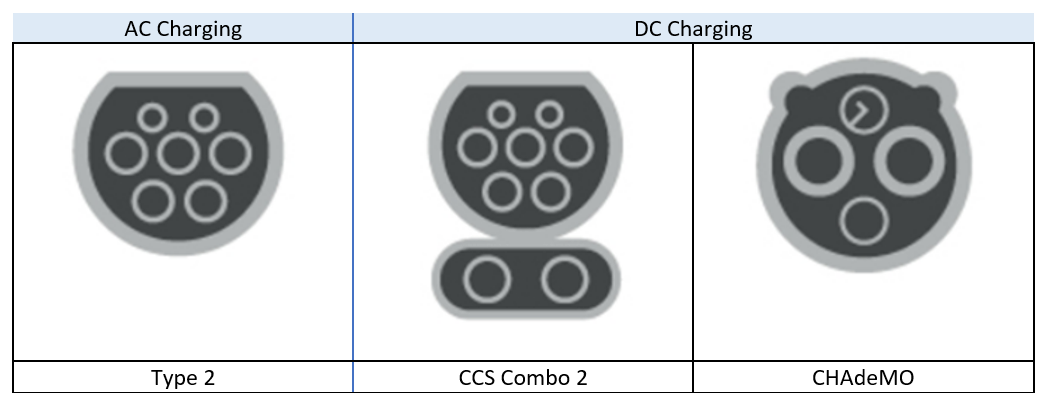
Photo: Interplex
While you will not have an issue with finding a compatible charging gun in Singapore, the charging speed will vary depending on the charger used and the onboard charger of your EV. The traction battery pack in your EV can only be recharged by DC power. When using an AC charger, the current will have to go through your onboard charger and be converted to DC before it can charge your battery. Hence, even if you use a 22kW AC charger, the speed may be limited by your 10kW onboard charger. It is thus useful to know what your onboard charger rating is, to estimate your charging duration.
On the other hand, since a DC charger supplies DC power, the battery can be directly recharged without involving the onboard charger, hence giving it the name ‘fast charging’. As a large amount of power is being transmitted during DC charging, the battery management system would cool the battery pack and prevent it from being overheated. It is usually not recommended to use DC charging excessively to preserve battery life, but please do consult the EV user guide from your EV manufacturer for more details.
Though charging a vehicle may seem foreign to some, it is actually a very simple process, and usually the same for most public chargers. All one needs to do is to retrieve the charging gun from the charging point and insert it into the charging port of their vehicle. Thereafter, activate and stop charging, and pay for the charging transaction with the use of a mobile app. It is that straightforward!
Here at Volt, we provide end-to-end EV charging solutions, from installation to operation and maintenance to customer service support. With our wide range of AC and DC chargers, we are able to customise our solutions to suit various needs or constraints.
Before using Volt’s chargers, drivers are welcome to download our Volt EV charging app. The Volt EV charging app was designed to ensure a smooth and pleasant user experience. Besides starting and stopping the charging session, the Volt EV charging app also provides information on our charging stations, including their pricing, power rating available capacity as well as the carpark rates they are stationed in. In addition, it contains a multitude of functions such as locating drivers’ nearest charging points, monitoring their charging status, making payments, and reviewing their transaction history. For more information on using Volt’s chargers, visit here!
We often hear people worrying about not having a place to charge their EVs when discussing whether or not to buy an EV. However, this concern may soon become trivial as Singapore seeks to lay out 60,000 charging points by 2030. Additionally, towns will be EV-ready by 2025 with all HDB carparks being equipped with at least 3 chargers for public use. Looking for a charging point to recharge your EV will certainly be easier and charging your EV will soon be as convenient and simple as refuelling an ICE vehicle.
The government has also taken a step further to alleviate the troubles of owning an EV by standardising all EV charging connectors to be used in Singapore. Type 2 connector will be required for AC charging while DC charging will use either a CCS Combo 2 or CHAdeMO connector head. All EVs sold and all charging points in Singapore would have to comply to these specifications so you will not need to worry about not finding the suitable charging gun!
Photo: Interplex
While you will not have an issue with finding a compatible charging gun in Singapore, the charging speed will vary depending on the charger used and the onboard charger of your EV. The traction battery pack in your EV can only be recharged by DC power. When using an AC charger, the current will have to go through your onboard charger and be converted to DC before it can charge your battery. Hence, even if you use a 22kW AC charger, the speed may be limited by your 10kW onboard charger. It is thus useful to know what your onboard charger rating is, to estimate your charging duration.
On the other hand, since a DC charger supplies DC power, the battery can be directly recharged without involving the onboard charger, hence giving it the name ‘fast charging’. As a large amount of power is being transmitted during DC charging, the battery management system would cool the battery pack and prevent it from being overheated. It is usually not recommended to use DC charging excessively to preserve battery life, but please do consult the EV user guide from your EV manufacturer for more details.
Though charging a vehicle may seem foreign to some, it is actually a very simple process, and usually the same for most public chargers. All one needs to do is to retrieve the charging gun from the charging point and insert it into the charging port of their vehicle. Thereafter, activate and stop charging, and pay for the charging transaction with the use of a mobile app. It is that straightforward!
Here at Volt, we provide end-to-end EV charging solutions, from installation to operation and maintenance to customer service support. With our wide range of AC and DC chargers, we are able to customise our solutions to suit various needs or constraints.
Before using Volt’s chargers, drivers are welcome to download our Volt EV charging app. The Volt EV charging app was designed to ensure a smooth and pleasant user experience. Besides starting and stopping the charging session, the Volt EV charging app also provides information on our charging stations, including their pricing, power rating available capacity as well as the carpark rates they are stationed in. In addition, it contains a multitude of functions such as locating drivers’ nearest charging points, monitoring their charging status, making payments, and reviewing their transaction history. For more information on using Volt’s chargers, visit here!